PEOPLE IN STEM
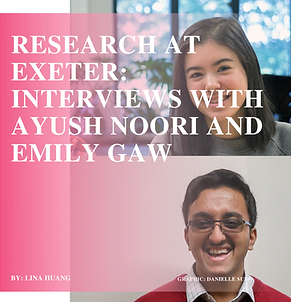
RESEARCH AT EXETER:
INTERVIEWS WITH AYUSH NOORI AND EMILY GAW
By lina huang
I studied Alzheimer's, Parkinson's and ALS, or amyotrophic lateral sclerosis, also known as Lou Gehrig's disease. Currently I'm working on two major initiatives. The first one centers on cells called astrocytes and microglia, or the neural support cells in the brain. These cells are known to have a distinct phenotypic reaction to Alzheimer's, which may underlie disease pathogenesis. Therefore, we are using human brain tissue to elucidate the specific driver drivers of this phenotypic change, which is commonly known as astrocyte reaction or astrogliosis. The other project I'm working on is an analysis of human transtomics data across Alzheimer's, Parkinson's and ALS to identify both shared mechanisms of pathology as well as disease specific expression signatures.

Affectionately called “Doc J.” by her students, Dr. Johnson has been a science teacher here at Phillips Exeter for over a decade. She teaches both physics and chemistry, and she serves as a dorm faculty in Lamont Hall and an advisor to Catholic Exonians. I had the pleasure of sitting down with her to talk about her journey to teaching at the Academy.
Could you tell us a bit about your work in STEM before teaching at Exeter?
So, there are two parts of my career. Before I taught at Exeter, I taught physics and chemistry at a day school- still private school- in Ohio. But before that, I was a working scientist. I got my PhD at Wash U, did some research at Harvard, and then was doing postdoctoral research at the University of California Irvine. Science goes in a variety of ways; sometimes science took a sharp left turn, but my focus always tried to be on what we call synaptic development.
Analysis of the Historical
vs. Current Climate in STEM
By isabel carden
With so many recent advancements in the world of science, it is no surprise that STEM has become more prevalent in both schools and modern society. According to the National Science Foundation, the number of Americans working in science or in engineering has grown from 1.1 million in the 1960s to nearly 6 million today, and this number is projected to grow to 9 million in the next few years. So what exactly has led to this ever-expanding STEM climate, and how are we at Exeter fostering its growth?


Meyerhoff program
By kaylee chen
In the 21st century, low diversity in STEM fields has been recognized as a significant issue. As a result, people are working to raise awareness and encourage underrepresented students to pursue STEM degrees. One example, the Meyerhoff Scholars program, has already been successful in this endeavor and is an effective basis for other programs that will hopefully develop in the future. Founded in 1988 by Robert Meyerhoff and Freeman Hrabowski in Baltimore, Maryland, the program focuses on increasing minority representation in STEM programs at the University of Maryland in Baltimore County (UMBC). Its purpose is to provide financial assistance, mentoring, and research experience to African American undergraduate students committed to obtaining Ph.D. degrees in math, science, and engineering.
A profile of lauren underwood - science in government
By Alexandria Westray
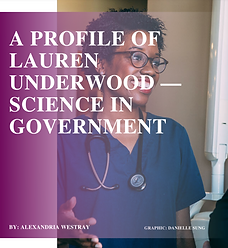
In the past ten years, only three percent of the proposed legislation regarding health and environmental issues was enacted. On top of this, many leaders in government glaze over science-related policies, so important laws are rarely ratified, despite ample objective evidence. To combat this, some scientists have decided to take their experience and education to the Capitol Building. Lauren Underwood is one of eight representatives who were recently elected in 2018, making her a pioneer of STEM in government.
Gender Inequality in Science,
How It Can Be Solved
By danielle sung and brooke ottaway
In the current generation, there are few girls and fewer women that take an interest in STEM. As the future jobs look increasingly digital, it will greatly affect the way we live. At most, 55% of the jobs will have a strong demand for technological skills, but by the time girls reach the age of higher education, only 30% choose STEM-related fields of study, particularly science, and the enrollment of mathematics, manufacturing, and health are even less.

Billy Menken and EOPS
By Noel Gomez
This year, 2019, marks the 50th anniversary of the first mission to the moon and the first man on the moon, Neil Armstrong. It seems though, that it won’t be much longer before mankind makes even more regular trips to the moon and even beyond that. An article from Express, a news publication in the UK, presents the possibility of a “Space Race 2.0” and discusses the possibility of commercial space travel becoming sustainable and frequent by the 2030s. With companies around the world—including SpaceX, Blue Origin, and Firefly—putting more time and resources into space travel, interest in the field is beginning to peak.

AI Computer Graphic Technologies in Movie Production
By Minseo KIM

Artificial Intelligence has become increasingly prominent throughout the last decade, and it’s being applied to various fields. Around the end of 2018, Google’s AI firm DeepMind took new strides in the medical sector by introducing AlphaFold, a program that determines the shape of a protein, like Cas 9, based on its amino acids information held in the DNA sequence. Machine Learning (ML) is also progressing in areas like facial recognition using convolutional neural networks (CNN), voice synthesizing, music composition, natural language processing, climate predictions, and so on and so forth.
History and Evolution of STEM in the U.S
By Neha Nedumaran
In the 1990s, the U.S. national science foundation first used the acronym SMET when referring to career fields centered on the disciplines of Science, Technology, Engineering, and Mathematics. In 2001, American biologist Judith Ramaley, rearranged the letters to form STEM. Since then STEM has been extended to many countries outside the U.S.
Throughout history, prevailing political movements tend to influence major reforms, especially in education. The event that set the U.S. on the path of technology and innovation was the launch of the Russian satellite, Sputnik, into space.

Risa Wechsler: Mapping the Invisible
By Ellie griffin
Even if you do not know much about cosmology, you have probably heard of the two most famous cosmologists: Carl Sagan and Neil DeGrasse Tyson. Their work in popular culture, such as with well-known tv series, has brought the field of cosmology more into the public eye. Still, however, many confuse the name cosmology with similar sounding cosmetology or astrology, though cosmology is a subfield of physics. While similar to astrophysics, cosmology focuses on questions of a larger scale: the size of galaxy clusters and up to the scale of the universe or multiverse. One of the largest charges for cosmologists of our time is to learn more about dark matter and dark energy, which combined make up about 97% of our universe and of which very little is known.

stem at exeter
By tanya das
STEM. Science, technology, engineering, and math. According to Forbes, the US had 568,000 STEM graduates in 2016. Only 16% of high schoolers are both proficient at math and interested in STEM careers. How are these statistics reflected at Phillips Exeter?
When first coming to Phillips Exeter, the plethora of courses and clubs can be quite intimidating. There are 450+ courses, a fifth of which are STEM courses, and over a 100 clubs, a third of which are also STEM-oriented. How can you ever choose?
Well, let’s start with what’s required. All high schoolers are required to take math, and Exeter is no different. Exeter Math consists of 7 problem sets with around a 1,000 questions in each. Problems, but no solutions… In classes, instead of having a teacher lecturing, students work together to share their solutions to homework problems and dive deeper into mathematical concepts.

STEM MINORITIES INTERVIEW
By aLETHEIA zOU

Which part(s) of your identity do you feel most isolates you in STEM?
Kai Lockwood, upper, day stud, they/them
I think the part of my identity that isolates me the most in the STEM fields is being non-binary. It is isolating because I have never met or known of a mentor or someone who is older than me in the STEM fields who is non-binary. I am sure there are people out there but for every other part of my identity, being bi, being disabled, I have adults who I can look up to in the STEM fields and see okay this is someone I could be like when I am older and as I have said previously being non-binary there really isn't anyone.
Anonymous, lower, Merrill, she/her
Probably being a girl in stem; I come from a heavily Asian middle school, so my race hasn’t been too big a deal in my life. However, being a girl is pretty isolating because it’s one of the attributes you can easily and directly see.
Lise Meitner: The Nobel Mistake
By Zoe HERMAN

In 1944, Lise Meitner was stripped from the prize she justly deserved for discovering nuclear fission and serves as a prime example of the inequalities women in STEM are subject to. Meitner was the second woman to earn a doctorate degree at the University of Vienna. She was born in 1878 and in 1905 earned her degree in physics. She made many extraordinary discoveries but her work was never recognized. Women represent a very small percentage of people in STEM and receive significantly less money than their male counterparts. Luckily, we can see vast improvements today from ten, fifty, or a hundred years ago, when the situation for women in STEM was much worse.
Katherine Johnson: the inspiration behind hidden figures
By LEILA HERMAN
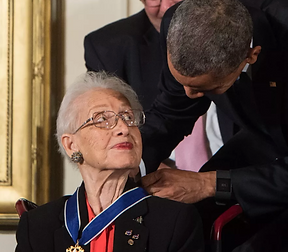
After its release in 2017, the movie Hidden Figures was nominated for three Academy Awards. The movie owes its success to not only a talented cast and director, but also to the moving, real story of three talented African American women working at NACA (now known as NASA) in the 1950s. During their time there, the three scientists, and in particular Katherine Johnson, faced racial and gendered discrimination, despite their exceptional accomplishments.
Johnson was always a talented mathematician. She grew up in White Sulphur Springs, West Virginia, where she attended school until her 8th grade year. Already she started to show her bright intellect, skipping several grades...